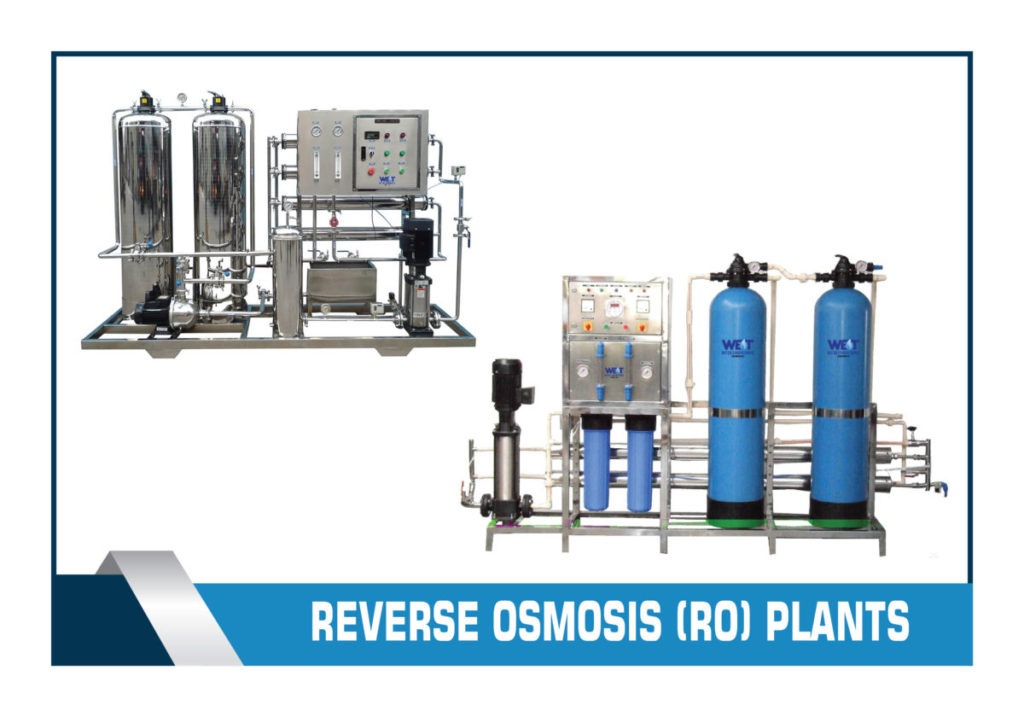
Reverse osmosis, water passes through a semipermeable membrane from a more concentrated solution to a less concentrated one under the influence of a pressure exceeding the difference in the osmotic pressures of both solutions. The membrane works to let water molecules pass through, but the main task is to prevent substances and impurities dissolved in it. Reverse osmosis is widely used in various technologies for purifying water from impurities and substances, including for desalination of water and purification of drinking water. In the process of water purification, many impurities and substances dissolved in it are retained on the filter membrane. To overcome the osmotic pressure on the membrane, water is supplied under a pressure of at least 3 and up to 17 atm. In industrial Ro plant , synthetic semi-permeable membranes of various models Filmtec 50G, Filmtec 75G, Filmtec 100G, Vontron 300G, Vontron 400G are often used. Retains high molecular weight pollutants, but passes low molecular weight substances, such as gases, such as oxygen, chlorine, carbon dioxide, etc. Some of the gases can affect the taste of water. A semi-permeable reverse osmosis membrane is a key element in a industrial Ro plant . The source water is supplied to the membrane, which has been preliminarily prepared by the lower stages of the reverse osmosis system, followed by separation into two streams, purified and desalted, called permeate, and water containing concentrated impurities, called a concentrate, which is drained into the sewer. The strengths of filters, where reverse osmosis technology is used, is virtually complete sterilization, distillation of the water leaving the system. Water molecules pass through the installation – 0.3 nm in size, but most of the chemical impurities of biological origin , and more specifically microorganisms and viruses (from 20 to 500 nm) , are also retained and removed . The need to actually completely purify water from impurities is certainly an advantage, but this is also a drawback. As of 2013, scientists do not confirm the harm of water obtained using reverse osmosis technology. For those who are concerned about this issue, reverse osmosis systems with a mineralizer and a structurizer are produced.
Reverse osmosis membrane – how does it work?
The answer to this question is incredibly difficult to find on the Internet. This is due to the fact that the authors of the articles are weak in physics and chemistry and rewrite the same stupidity one after another, further confusing the layman. Let’s figure out how, after all, is water transported through a semipermeable membrane? The initially proposed explanation, later recognized as erroneous , but so beloved by the masses because of the simplicity of the explanation – the “sieve” model – is that water molecules are separated from the solution due to their small size. In practice, even ordinary salt molecules (sodium ions and chloride ion) are comparable in size to water molecules, and some pollutants are also smaller, which eliminates the possibility of such a principle of operation In fact, the membrane conducts through itself only water molecules on a principle reminiscent of the movement of an electric current. It is based on the principle of capillary-filtration selective permeability. A membrane made of a special material is capable of forming hydrogen bonds with water. A film of bound water adheres to the inner and outer sides of the membrane and fills all the pores of the membrane. Bound water is significantly different in physical properties from water in a free state formed by a network of directed hydrogen intermolecular bonds. Only a water molecule can penetrate and pass through the membrane into a layer of bound water. This is the principle and it has nothing to do with the notorious sieve. If you still have questions, we recommend watching a fun and entertaining video about the membrane device.
Reverse Osmosis Filter – Saving for the Home:
Let’s talk about reverse osmosis water filters. In regions with poor tap water (and this is practically the whole ofPakistan , with the exception of cities with a population of over one million) – this is the only budget way to provide households with clean drinking water.
For further information click here : Ro plant price in Pakistan
 watertreatment